
LumiSystem™: What Patients Should Know
What Is LumiSystem?
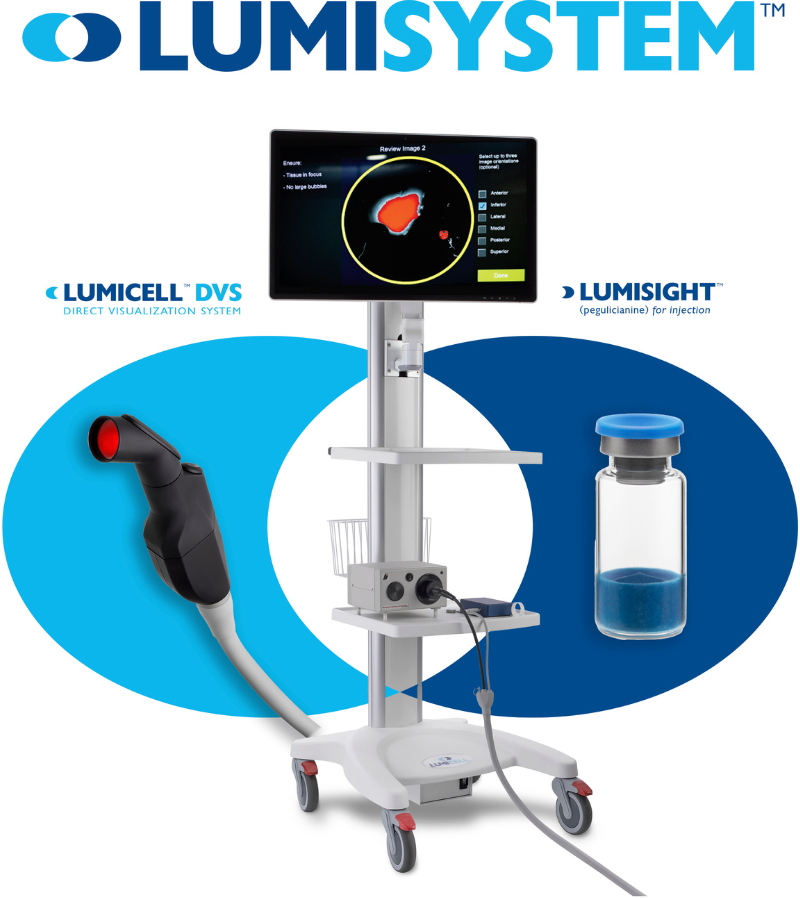
LumiSystem™ is an innovative technology used during lumpectomy surgery for breast cancer to help surgeons look inside the breast to see and remove residual cancer tissue in real time. It combines:
- LUMISIGHT™ (pegulicianine) a fluorescent imaging agent given before surgery,
and - Lumicell™ Direct Visualization System (DVS) a handheld imaging device that
helps surgeons scan the surgical area for remaining cancer cells.
Together, they allow surgeons to illuminate cancerous tissue inside the breast cavity once the main tumor has been removed.
With the use of LumiSystem, patients may benefit from more accurate surgery and reduced need for follow-up procedures.
Why Does This Matter to You?
During a lumpectomy (breast-conserving surgery), the goal is to remove the tumor and a small margin of healthy tissue to get “negative margins” (no cancer present at the edges of the removed tissue). However, standard methods don’t always detect cancer left behind. Studies show that up to one-third of patients may need a second surgery to remove residual cancer that was missed the first time.
LumiSystem helps surgeons identify remaining suspicious tissue during the initial surgery so they can remove it immediately, potentially reducing the need for additional procedures.
Just knowing that my doctor took the time to take a second look for residual cancer during my surgery brought me great peace of mind, and I would recommend it highly
Nancy, Actual Patient

What Are the Benefits?
Patients may experience:
- Better detection of residual cancer that could be missed otherwise.
- Reduced likelihood of needing a second surgery.
- Potential peace of mind from more complete removal during the first procedure.

How LumiSystem Works
- Before Surgery – Patients receive an intravenous (IV) injection of LUMISIGHT 2-6 hours before imaging
- During Surgery – After the primary tumor is removed, the surgeon uses the LumiSystem handheld probe to scan the cavity. The system uses special light to make suspicious tissue glow if they have taken up the LUMISIGHT agent.
- Real-Time Guidance – The images show up with a red signal on a screen, helping the surgeon decide if more tissue should be removed.
This is done in addition to (not instead of) standard care. The removed tissue is still sent to pathology for assessment.

Are There Potential Risks or Side Effects?
As with all medical procedures, there are potential risks and side effects to be aware of.
- Allergic reactions: LUMISIGHT can cause serious hypersensitivity reactions, including anaphylaxis. Anaphylaxis has occurred in 4/726 (0.6%) of patients in clinical studies. LUMISIGHT is contraindicated in patients with a history of hypersensitivity reactions to pegulicianine.
- Typical side effects: Most common are hypersensitivity and a temporary abnormal color in urine.
- Clinical limitations: A lack of fluorescence doesn’t guarantee no cancer, and a positive signal may sometimes come from noncancerous tissue.
Your surgeon will discuss safety and whether LumiSystem is right for you prior to surgery.

Find a Surgeon Using LumiSystem
Some of the leading cancer centers in the U.S.A. are utilizing LumiSystem today, and the list is growing. If you’re facing breast-conserving surgery, ask your surgeon whether LumiSystem is an option for you. See below for some physicians offering this technology:
Lumicell does not endorse or recommend a particular physician. This list is comprised of physicians who offer Lumisystem and have agreed to be included on this list.
Lindsey W. Beakley, MD
- Breast Surgical Oncology
- Southern Cancer Center, 6701 Airport Blvd. Building B, Suite 222, Mobile, AL 36608
- (251) 633-0663
- dr.beakley@southerncancercenter.com
- southerncancercenter.com
Donna Lynn Dyess, MD, FACS
- Surgery
- University of South Alabama, 1601 Center Street Mobile, AL 36604
- (251) 660-5763
- ldyess@health.southalabama.edu
Sheldon Feldman, MD
- Breast Surgery
- Montefiore Medical Center
- 1250 Waters Place, Tower 1, Bronx, New York 10461
- 718-920-2700
- Breast Surgical Oncology
- Good Samaritan University Hospital
- 393 Sunrise Highway, 2nd Floor, West Babylon, NY 11704
- 631-376-3145
Jennifer Montes, MD, MPH
- Breast Surgery
- Hunterdon Medical Center
- 121 Rt 31 South, Suite 1200, Flemington, NJ 08822
- 908-237-4106
- jmontes@hhsnj.org
- Hunterdon Breast Surgery Center | Hunterdon
Ethan Ravetch, MD
- Breast Surgery
- Montefiore Medical Center
- 1250 Waters Place, Tower 1, Bronx, New York 10461
- 718-920-2700
Ruth Samson, MD
- Breast Surgery
- Montefiore Medical Center
- 1250 Waters Place, Tower 1, Bronx, New York 10461
- 718-920-2700
Jacqueline Tsai, MD, FACS
- Breast Surgery
- Stanford Healthcare, 900 Blake Wilbur Drive, Palo Alto, CA 94304
- https://stanfordhealthcare.org/medical-clinics/breast-cancer-program.html
Irene Wapnir, MD
Looking for more information?
If you are looking for more information on Lumpectomy surgery and whether this is the right choice for you, visit LearnLookLocate.com for an educational resource on Lumpectomy and an indepth, expert discussion with Dr. Barry Rosen.
Frequently Asked Questions
Q: How can I have LumiSystem used during my surgery?
A: Ask your care team if LumiSystem is appropriate for your lumpectomy. If yes, your
surgeon or nurse will explain the procedure to you ahead of time.
Q: Is this standard for all lumpectomies?
A: Not yet. It depends on the surgeon’s practices and availability of the technology.
Q: Does it increase surgery time?
A: It adds only minutes to the procedure while providing real-time guidance.
What is LumiSystem™?
LumiSystem is the combination of the following FDA approved products – LUMISIGHT™ (pegulicianine) and Lumicell™ DVS. These products are used as an adjunct by surgeons to intraoperatively detect residual breast cancer, in real-time, during lumpectomy surgery.
IMPORTANT SAFETY INFORMATION
What is LUMISIGHT (pegulicianine) and Lumicell DVS?
- LUMISIGHT (pegulicianine) is an optical imaging agent and Lumicell DVS is a fluorescence imaging device. LUMISIGHT and Lumicell DVS, in combination, are used in adults with breast cancer to help detect any remaining cancerous tissue at the surgical site following removal of the primary specimen during a lumpectomy procedure.
What is the most important information I should know about LUMISIGHT?
- Hypersensitivity Reactions: LUMISIGHT may cause serious hypersensitivity reactions, including anaphylaxis. Anaphylaxis has occurred in 4/726 (0.6%) of patients in clinical studies. Tell your doctor if you have any history of hypersensitivity reactions to pegulicianine or to contrast media or products containing polyethylene glycol (PEG). Your healthcare provider should have emergency resuscitation drugs, equipment, and trained personnel available during the use of LUMISIGHT. Healthcare providers should monitor all patients for hypersensitivity reactions and if one is suspected, immediately discontinue the injection and initiate appropriate therapy.
- The most common side effects (≥1%) include hypersensitivity and an abnormal color in urine.
What additional important information should I know about LUMISIGHT and Lumicell DVS?
- Adjunctive Use: Lumicell DVS is for use as part of the lumpectomy procedure and is not a replacement for the standard of care lumpectomy procedure and pathology.
- Risk of Misdiagnosis: The absence of a signal in surgery does not rule out cancer. Additionally, a positive signal may be seen in noncancerous tissue.
- Interference from Dyes Used for Sentinel Lymph Node Mapping: Your healthcare provider should avoid use of dyes before imaging the lumpectomy cavity in patients who have received LUMISIGHT.
- Other Risks: Using the Lumicell DVS handheld probe may cause tissue damage or infection.
You are encouraged to report negative side effects of prescription drugs to the FDA. Visit MedWatch or call 1-800-FDA-1088. Please see the LUMISIGHT Prescribing Information, including Boxed Warning, and Lumicell DVS Instructions for Use. For complete product information www.LumiSystem.com.
Rx only